| DISCUSSION: |
| M800 Discussion List |
| CONTACTS: |
| Contact Washington |
|
Contact
House Aviation |
| Contact FIRO |
|
TWA Flight 800: An Inadequate Official Investigation Published 7/14/02 July 17, 2002 marks the six year anniversary for the crash of TWA Flight 800. The National Transportation Safety Board (NTSB) determined that a spark inside a fuel tank was the most probable cause for the crash. No conclusive evidence for the spark or its source was ever found, and the NTSB ended its four-year investigation in August of 2000. In its final report on the crash and during two public hearings, the NTSB misrepresented or ignored evidence that contradicted its findings. A significant quantity of evidence, analyses, and investigative documents that contradicts the official crash sequence has been left unaccounted for by the NTSB. Flight 800's official crash sequence was released during the NTSB's December 1997 public hearing on the crash in the form of an animation.

Figure 1 : View looking south. Four stages of the official TWA Flight 800 crash sequence.[1, 2]Facts from the official crash sequence of Flight 800: 1) Flight 800 traveled eastward at all times--from the moment it first exploded until it hit the water.[3] 2) Flight 800 began a brief climb to the east from an altitude of 13,800 feet (2.6 miles).[4] 3) No object rose from the surface, climbed vertically, headed westward, or impacted with Flight 800.[1]
Evidence in Conflict with the Official Crash Scenario More than one hundred eyewitness accounts contradict the official crash sequence. Many saw an object rise from the surface and/or head straight up. Others watched an object rise westard, a direction the crippled jetliner never traveled. Several others said the streak impacted with Flight 800.[5] Rather than interview these witnesses or invite them to participate in a public hearing, the NTSB banned their accounts from the first Flight 800 public hearing in 1997 and misrepresented their accounts at the final public hearing in 2000. Witness 649 (name redacted by the FBI) provided investigators with a detailed description of airborne events surrounding the crash of TWA Flight 800. Click to animate: 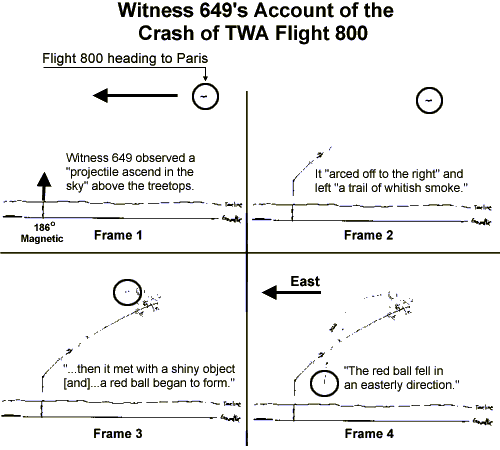
Figure 2: Frames 1-4 are based upon a hand drawing given to FBI agents by eyewitness 649. Flight 800's position shown above was determined from the compass bearing line to the rising projectile and landmarks that witness 649 provided to investigators. Flight 800 was not included in the original drawing, and witness 649 never stated that he recognized an aircraft. His account states that he observed a projectile rise, arc to the right, and meet a "shiny object" in the sky just prior to seeing a fireball erupt. The NTSB concluded that the red ball he saw falling to the surface was Flight 800.[2] All quotations in this figure have been taken from the official FBI witness documents of eyewitness 649.Witness 649's observations conflict with the official crash sequence in several areas. First, an object is described rising vertically from an area close to the horizon. The object then turns westward and apparently "impacts with"[6] Flight 800. Flight 800 then explodes and continues on its eastward course, falling to the ocean. For other facts concerning witness 649's account, see item nine of FIRO's petition to the NTSB. The NTSB never interviewed witness 649, but did misrepresent his account at the NTSB's final hearing on the crash. The NTSB stated that his observations were restricted between two flagpoles. And since Flight 800 was not between these flagpoles when it lost electrical power, witness 649 could not have seen it during the initial explosion. But there were no flagpoles.
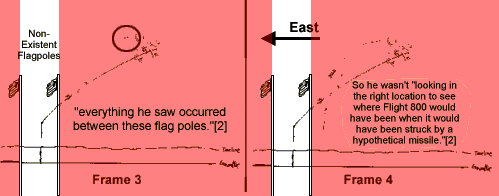
Figure 3: View looking south from Westhampton Beach High School. From Figure 2, the last two stages of witness 649's observations. Shaded areas are where the NTSB stated that witness 649 wasn't looking.Witness 649's FBI witness summary describes an object apparently impacting with Flight 800 between two "buildings,"[6] not flagpoles. And from witness 649's viewpoint, Flight 800 did lose electrical power between these two buildings. This is where the witness sketched a large midair explosion for the FBI (see Figure 3 above). There were never any flagpoles where the NTSB "believed"[2] there were. Click here for an animation based upon witness 649's official FBI sketch. For a detailed accounting of the NTSB's misrepresentation of the TWA Flight 800 eyewitness evidence at the August 2000 Sunshine Hearing, see Attachment VI of FIRO's petition to the NTSB.
Several radar targets from at least four separate radar sites indicate that wreckage exited the right side of the aircraft at high speeds. All of these radar targets contradict the official crash sequence, which offers no explanation for their appearance. The NTSB has not discussed these targets or their implications in its final report or at any public hearing. A very powerful force was needed to launch wreckage out the right side of the aircraft almost precisely when the aircraft lost electrical power. Some of this wreckage evidently landed in a debris field that was officially never located--a debris field that could have contained the "significant missing structure" that officials believe exited the plane early in the crash sequence.[7] For a detailed accounting of the high-speed radar targets, see item four of FIRO's petition to the NTSB. Other items left unaccounted for by the NTSB are discussed in detail within FIRO's petition to the NTSB. Some of the petition's topics are listed below:
References: 1. NTSB, AIRCRAFT ACCIDENT REPORT, In-flight Breakup Over the Atlantic Ocean, Trans World Airlines Flight 800, Boeing 747-131, N93119, Near East Moriches, New York, July 17, 1996. NTSB Public Docket, 2000. 2. Mayer, D., NTSB Witness Group Sunshine Hearing Presentation. NTSB Public Docket (hearing transcripts), 2000. 3. Pereira, C., et al., Airplane Performance Study. NTSB Public Docket, 1997. 4. Crider, D., NTSB Exhibit 22C: Main Wreckage Flight Path Study. NTSB Exhibit Items, 1997. 5. Stalcup, T.F. and T. Shoemaker, Review of the Official TWA Flight 800 Eyewitness Reports. Flight800.org, 2001. 6. Mayer, D., Witness Group Chairman's Factual Report. NTSB Public Docket, 2000. 7. Wildey, J.F., Metallurgy/Structural Group Chairman Factual Report: Sequencing Study. Exhibit 18A: NTSB Baltimore Hearings, 1997. |
